
Your CubeSat Mission Analysis Tool
One coupled problem, not five separate studies
Eclipse fraction sets the cold case. The cold case sets the power and battery margin. Orbital decay moves all of them over the life of the mission. CMAT propagates the whole thing from one specification of the spacecraft and its orbit, and returns the orbital, thermal, power, attitude and ground contact results together.
Enrolled students get twelve months free, 10 analyses a day. Sign up with your university address.
Open it and run
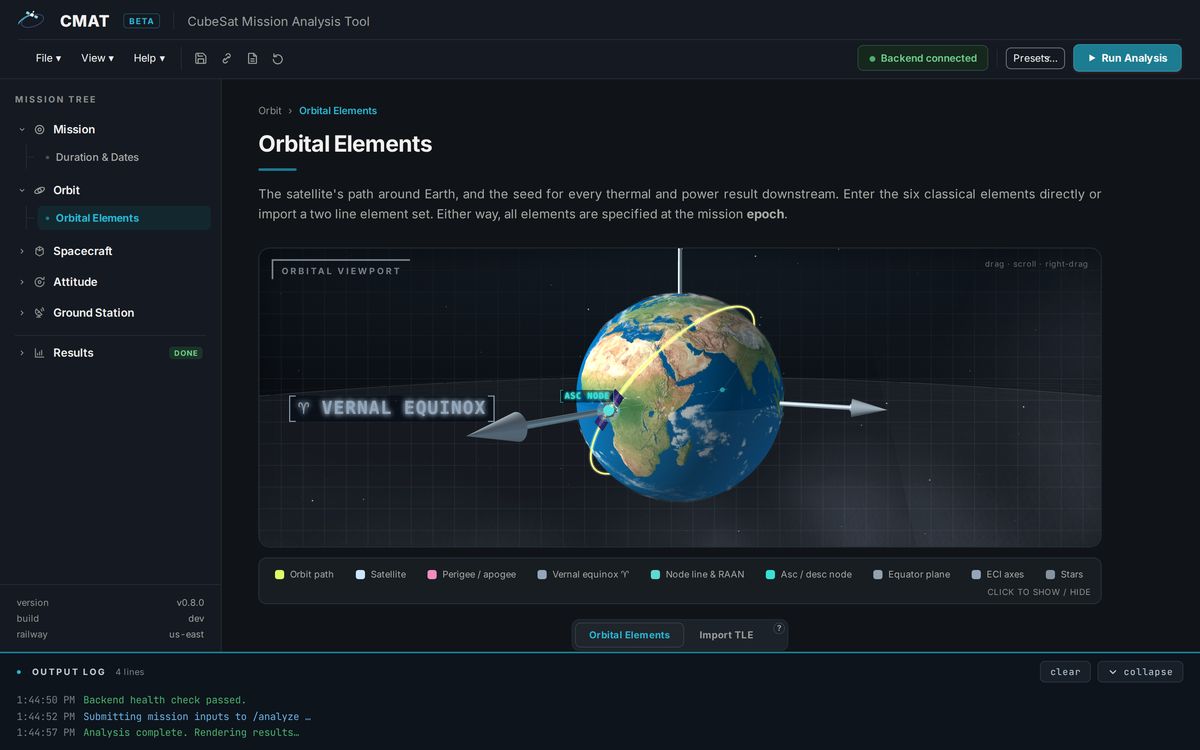
It runs in the browser. There is nothing to install and nothing to configure before the first analysis.
One run, every domain
Orbit, thermal, power, attitude and ground contact all come out of the same propagation, together.
Results in about ten seconds
A 360 day mission with its thermal, power and contact geometry. Quick enough to compare configurations rather than settle on the first one.
Answers while the design is still open
A full mission analysis is a single run: set the spacecraft and the orbit, press run, and the orbital, thermal, power, attitude and contact results come back together. Changing an input and running again is quick, which is what makes it worth comparing several orbits and configurations rather than settling on the first one and discovering its consequences later.
What it reports
- Orbital decay, lifetime and reentry date
- Nodal drift, eclipse ratio and beta angle geometry
- Bounding hot and cold thermal cases
- Available power across the whole mission
- Attitude under gravity gradient, aerodynamic, magnetic and solar torques, and the control effort to counter them
- Ground station passes, contact timeline and ground track
Where it applies, and where it does not
CMAT is specialised rather than general. Its models are formulated and tested for CubeSats in low Earth orbit, and that restriction is precisely what allows the orbital, thermal, power and attitude domains to be coupled natively. It is aimed at the concept and feasibility phase, where design freedom is greatest and where the choice of orbit and configuration still determines the rest of the programme.
It does not certify a design, and it does not replace the verification carried out before hardware is committed. Within its declared domain, it is built to be quantitatively defensible.
Cross-validated results
Results are cross-validated against established reference tools and against published flight data.
Start with the free version
Enrolled students get twelve months free, 10 analyses a day. Sign up with your university address.